


Bury the Devil Review: One-Shot Possession Horror Finds Dread in an Unexpected Setting


‘Bury the Devil’ Review: A One-Shot Possession Thriller Finds Dread in an Unexpected Setting
Possession films have spent decades returning to familiar territory. Children, priests, exorcisms and families confronting something they cannot explain have provided the foundation for countless variations on the genre. Adam O’Brien’s Bury the Devil doesn’t completely abandon those conventions, but it does find a less frequently explored setting for them, placing its supernatural story inside the home of an elderly woman living with dementia.
Arriving in limited theaters and On Demand from Brainstorm Media, Bury the Devil unfolds in real time and is presented as a single continuous shot. Emmanuelle Lussier Martinez stars as Julia, a caretaker looking after Evelyn (Dawn Ford), a woman whose declining health already creates uncertainty inside the home. When Evelyn’s estranged ex-husband Randall (Bill Rowat) arrives, pieces of the family’s history begin surfacing as the night takes a darker turn.
The continuous-shot approach immediately places additional pressure on director Adam O’Brien and cinematographer Benoit Beaulieu. Without traditional editing to control the audience’s attention, the house itself has to become an active part of the film. Rooms, hallways, darkness and seemingly routine movements through the property are used to establish the atmosphere before the supernatural elements fully take hold.
For the most part, that approach works. There is a persistent sense of something lingering around the edges of the frame, and O’Brien allows the environment to establish much of the dread. There are stretches where the film stays with that atmosphere longer than necessary, but the location becomes a recognizable part of the experience rather than simply a backdrop.
Dawn Ford is ultimately what holds much of Bury the Devil together. Her performance as Evelyn has to navigate dementia, vulnerability and the increasingly unsettling circumstances surrounding the character without making it immediately obvious where one ends and another begins. Ford handles those transitions particularly well and gives the film its strongest performance.
Martinez’s Julia is less developed by comparison. The character serves an important function in guiding the audience through the house and Evelyn’s situation, but the screenplay places so much emphasis on Evelyn and the mystery surrounding her family that Julia can occasionally feel secondary to the story unfolding around her. Rowat’s arrival as Randall gives the film another dynamic to work with as more of the family history begins entering the narrative.
Where Bury the Devil separates itself most effectively from other contemporary possession films is its elderly-care setting. Horror has repeatedly explored the uncertainty surrounding aging, illness and changing behavior, and dementia gives O’Brien another layer of ambiguity to work with before the film establishes its supernatural direction.
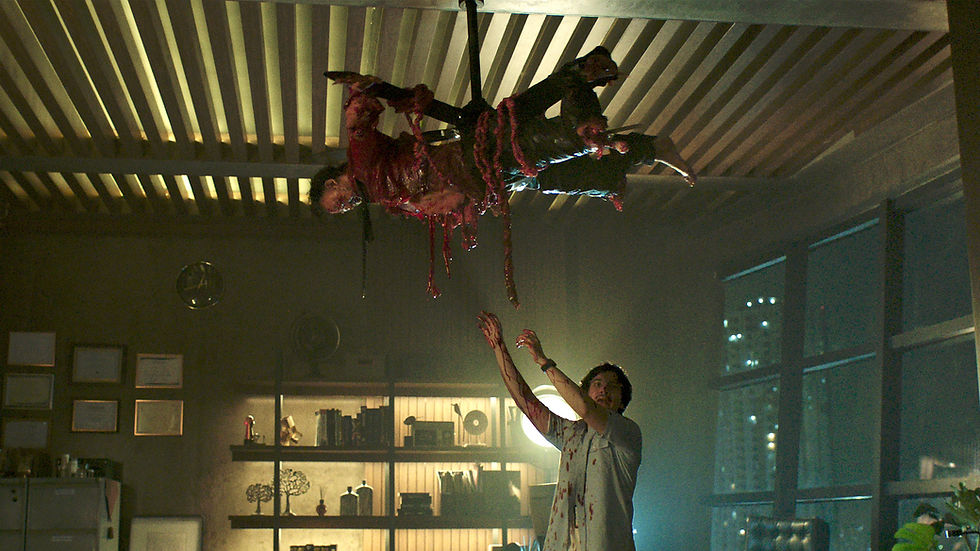
Once that direction becomes clearer, however, Bury the Devil begins drawing from more recognizable possession territory. There are echoes of decades of exorcism cinema as well as the more physically aggressive style of possession associated with films such as The Evil Dead. The setting changes, but some of the genre language remains familiar.
That familiarity produces mixed results. Several moments are genuinely creepy, particularly when Ford is allowed to command the frame and the continuous-shot presentation prevents the audience from escaping through a cut. Other sequences linger after their dramatic purpose has already been established, creating periods where the deliberate pacing becomes less about tension and more about waiting for the story to move forward.
The final stretch also becomes more chaotic than the controlled atmosphere that precedes it. After spending so much time carefully building its environment and relationships, the conclusion feels comparatively hurried. There are also elements revealed in the film’s marketing that would have carried considerably more impact if audiences had been allowed to encounter them without advance knowledge.
Still, the technical ambition deserves recognition. A continuous real-time horror film requires precise coordination between performers, camera movement, lighting and staging, and Bury the Devil uses the format for more than novelty. Combined with Ford’s performance, it gives the film enough identity to distinguish itself within an increasingly crowded possession subgenre.
Bury the Devil doesn’t reinvent possession horror, but its setting, one-shot construction and central performance offer a different route into familiar territory. The pacing occasionally works against the tension, and some of its ideas are more effective than others, but O’Brien largely accomplishes what the film sets out to do: create an intimate, atmospheric and genuinely creepy supernatural thriller within the confines of a single night.
3 out of 5


Comments