


FilmQuest 2026 Review: ‘The Peril at Pincer Point’ Is a Strange, Satisfying Journey Into Coastal Folklore

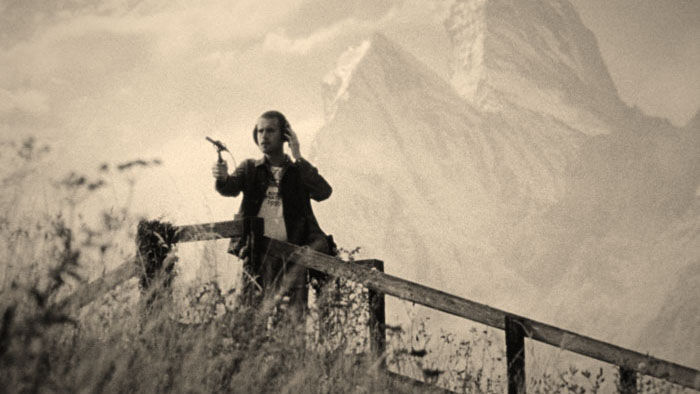
Some films draw viewers in with relentless action and shocking twists. Others build their appeal through atmosphere, mystery and the uneasy feeling that the world on screen might not be entirely real. The Peril at Pincer Point, directed by Jake Kuhn and Noah Stratton-Twine, belongs firmly in the latter category, delivering a black-and-white fantasy mystery that rewards patience with an engaging story and a satisfying conclusion.
The film follows Jim Baitte (Jack Redmayne), a sound engineer working at a studio where his superiors have begun to question his ambition and commitment to the job. Jim believes he has simply learned to work efficiently, but the studio’s leadership sees someone who has become comfortable rather than someone eager to develop his craft. With a high-profile filmmaker demanding an extraordinary sound for an upcoming project, Jim gets an unexpected opportunity to prove his worth when another sound engineer goes missing.
His assignment takes him to Pincer Point, a coastal community steeped in unusual local lore. Jim must track down a young woman (Alyth Ross) whose voice is supposedly essential to capturing the sound the filmmaker wants. What begins as a professional rescue mission gradually becomes something stranger as Jim encounters the town’s residents, learns more about its history and investigates the circumstances surrounding the woman’s disappearance.
The premise gives The Peril at Pincer Point a clear narrative objective, but the film’s appeal extends beyond the mechanics of Jim’s search. The town itself becomes a source of intrigue, with its inhabitants, shoreline and maritime atmosphere creating the impression of a place operating according to rules that outsiders may never fully understand. As Jim continues recording sounds and pursuing answers, the distinction between an ordinary assignment and a journey into something more mysterious becomes increasingly difficult to define.
Shot in black and white, the film uses its visual style to strengthen that uncertainty. The coastal setting, boats and isolated stretches of shoreline take on an almost dreamlike quality, giving the story the feeling of a folktale unfolding somewhere between reality and imagination. The monochromatic photography reinforces the atmosphere without making the film feel like an exercise in nostalgia. Instead, it helps establish a distinctive world in which the unusual elements feel like a natural part of the landscape.
The film also embraces its more fantastical details without overexplaining them. Oversized crustaceans appear throughout the story, adding another layer of strangeness to Pincer Point and its surrounding mythology. Rather than treating every unusual occurrence as a puzzle that must be solved immediately, the filmmakers allow these details to contribute to the film’s larger sense of mystery.
That approach may bring to mind Robert Eggers’ The Lighthouse, particularly in the way the isolated coastal setting and peculiar local atmosphere leave viewers questioning how much of what they are seeing should be taken literally. There is also a broader folk-horror sensibility at work, although The Peril at Pincer Point leans toward dark fantasy and mystery rather than relying on violence or conventional horror shocks.
Its pacing is another strength. Films built around enigmatic locations and folklore can become so absorbed in their own atmosphere that the narrative loses momentum. Here, Coon and Stratton-Twine keep Jim’s objective in view while allowing the mystery to develop around him. The result is a film that feels complete without overstaying its welcome, wrapping up in under 90 minutes while still making room for its characters, setting and central mystery.
That economy deserves credit. The Peril at Pincer Point establishes its premise, builds an unusual fictional community and delivers a full narrative arc without stretching the material into a longer feature. The story remains engaging because Jim’s professional predicament provides a relatable entry point into an increasingly unfamiliar world. His desire to redeem himself gives the journey a personal stake even as the surrounding events become more surreal.
The characters also help sustain the film’s appeal. Jim’s encounters with the residents of Pincer Point make the town feel populated by people rather than merely serving as a backdrop for strange imagery. Their personalities and connections to the local lore encourage curiosity about the community, allowing the film to maintain an engaging human dimension alongside its more abstract elements.
The performances further support the film’s understated approach. Jack Redman is among the cast members who help anchor the story, and viewers familiar with the independent genre scene may recognize some of the creative connections to other recent projects, including Litter Mates. Those overlaps are a welcome reminder of the collaborative relationships that often emerge within independent filmmaking, though The Peril at Pincer Point establishes its own identity through its setting and storytelling.
This is not a film designed for viewers seeking a fast-moving thriller filled with constant escalation, graphic violence or an abundance of conventional scares. Its pleasures are quieter and more deliberate, built around atmosphere, character interactions and the gradual discovery of a world that seems to exist just beyond the boundaries of everyday reality. Viewers who appreciate folklore-driven fantasy, unconventional mysteries and films that leave room for interpretation will find more to engage with here.
After spending considerable time on the festival circuit, The Peril at Pincer Point proved to be a pleasant surprise. Its reputation and continued presence at genre festivals had kept it on the radar, but the finished film delivers a more satisfying experience than expected. The combination of visual atmosphere, likable characters, measured pacing and a gratifying conclusion makes it an effective example of independent genre filmmaking working within a relatively modest runtime.
Ultimately, The Peril at Pincer Point succeeds by understanding what its story needs and resisting the temptation to stretch it beyond those boundaries. Its black-and-white imagery and coastal folklore create a memorable atmosphere, while Jim’s search provides enough narrative momentum to carry viewers through the film’s stranger turns. It may not satisfy everyone, particularly those looking for a more aggressive or conventional horror experience, but its distinctive mood and carefully controlled storytelling make it a rewarding festival discovery.
HMU Rating: 3.5 out of 5 stars


Comments