


‘Other Mommy’ Review: A Familiar Supernatural Nightmare That Never Builds Enough Mythology

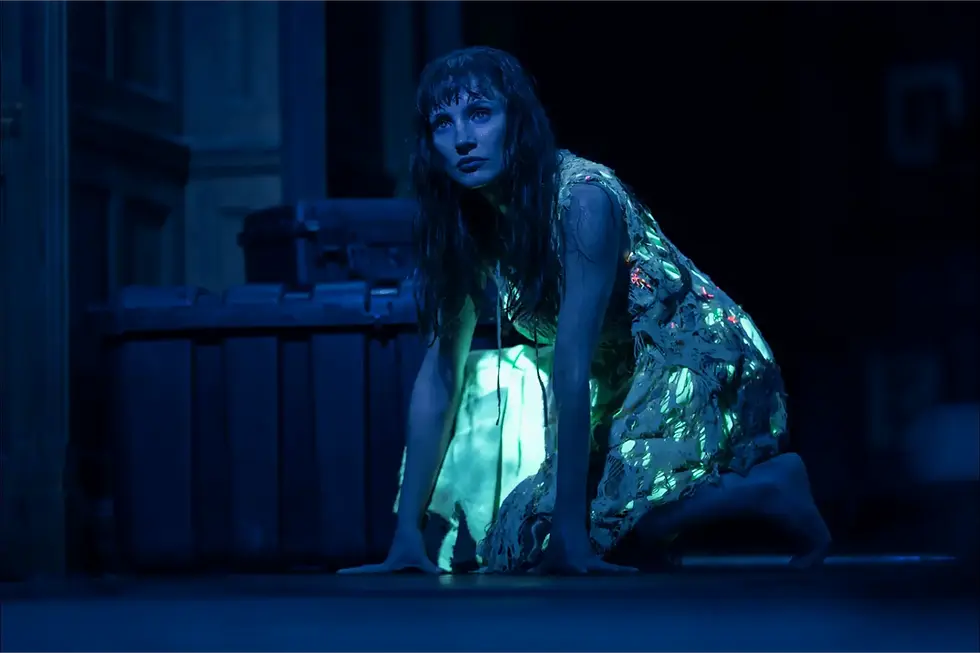
Rob Savage finds some effective scares and Jessica Chastain brings marquee value, but Other Mommy reveals too much too early and never develops its central horror enough to sustain the mystery.
There is an obvious appeal to pairing established talent with a filmmaker who has already demonstrated an ability to work effectively within horror. Other Mommy arrives with Jessica Chastain in front of the camera and Rob Savage behind it, a combination that immediately gives the film a level of visibility most supernatural horror releases never receive. Its early marketing only increased those expectations, promising a creepy, commercially accessible horror film built around the increasingly fractured relationship between a mother and daughter.
The ingredients are certainly there. The problem is that Other Mommy never develops them far enough.
Savage understands how to construct a jump scare, and the film contains enough unsettling imagery and carefully timed jolts to work on an immediate level. There are sequences here that should play particularly well with a packed theatrical audience, and the film occasionally creates the uncomfortable feeling that its supernatural world is somewhere viewers would rather not spend much time.
But scares are only part of the equation.
The deeper Other Mommy moves into its story, the more apparent it becomes that the mystery surrounding its central threat isn’t nearly as developed as the presentation surrounding it.
The film operates in familiar territory, using a troubled relationship between mother and child as the emotional foundation for supernatural horror. Family tensions and problems normally kept behind closed doors become the material through which something unnatural can enter the story. That approach isn’t inherently a problem. Horror has always found monsters inside domestic anxieties, and Savage has enough control over the film’s visual language to make that combination occasionally effective.
There is also a recognizable contemporary fascination with liminal environments, tunnels, elongated spaces and creatures emerging from places that seem disconnected from ordinary reality. Those ideas can produce striking imagery, but familiarity becomes a recurring issue. None of these ingredients feel particularly new, and Other Mommy rarely finds the additional wrinkle necessary to make them feel uniquely its own.
Comparisons to films such as Lights Out and Mama become difficult to avoid, not because Other Mommy is necessarily attempting to duplicate either film, but because all three operate within similar supernatural and familial territory.
Lights Out arguably found a cleaner mechanism for turning its central supernatural concept into sustained tension. Mama, meanwhile, built a more distinctive mythology around its spirit and the feral children connected to it. Whatever one thinks of those films individually, their monsters existed within supernatural frameworks that encouraged viewers to keep asking questions.
That is where Other Mommy struggles.
The film gives away a considerable amount relatively early, some of which audiences will already understand from the marketing. Once those cards are on the table, the story needs another layer of mystery to replace them. Instead, the mythology surrounding the central creature remains surprisingly thin.
That missing mythology matters.
Consider something like Smile. The effectiveness of that film isn’t simply the image of someone smiling unnaturally. The mythology surrounding the phenomenon gives the audience something to investigate alongside the characters. Every new piece of information changes the viewer’s understanding of what they’re watching.
Other Mommy has the presentation of that kind of supernatural horror without enough of the discovery.
As a result, the final stretch begins introducing information that feels less like the natural expansion of an established mythology and more like an attempt to make the pieces fit before the credits arrive. There are explanations, but explanation and mythology aren’t necessarily the same thing. A compelling mythology makes viewers want to understand the monster. An explanation simply tells them why something happened.
The performances can only compensate for so much.
Chastain gives the film obvious credibility and presence, but the role itself doesn’t demand something that feels uniquely dependent upon her. For a movie built around the relationship between a mother and child, the more consequential performance belongs to the young actress at the center of that dynamic. There are moments when that performance effectively carries the unease the film needs, and others when the material asks too much of familiar reactions and behaviors. That is less an issue with the performance than with what has been written around it.
Savage remains strongest when Other Mommy stops explaining itself and simply tries to frighten the audience. His instincts for timing, negative space and sudden visual disruption are evident. Several sequences demonstrate why he continues to be an interesting genre filmmaker even when the larger film surrounding those sequences doesn’t completely work.
There is a good horror movie somewhere inside Other Mommy.
Its foundation works. The domestic conflict gives the supernatural material somewhere emotionally recognizable to begin. The creature has visual potential. Savage can deliver the scares. And the film has enough polish to satisfy viewers looking for a straightforward theatrical supernatural horror experience.
What it lacks is the additional layer that turns a collection of creepy ideas into a memorable horror mythology.
That’s ultimately the frustrating part. Other Mommy doesn’t collapse because its central idea is bad. It feels incomplete because that idea could have gone considerably further.
The movie establishes its nightmare, shows us the monster and gives us enough scares to understand what Savage is trying to accomplish. It simply never gives us enough reason to remain fascinated by the thing hiding in the dark.
For casual horror audiences looking for a few effective jumps and a polished supernatural thriller, there is enough here to make Other Mommy an accessible October watch. More seasoned genre viewers may find themselves waiting for the film to reveal another layer that never quite arrives.
The names are there. The presentation is there. The scares occasionally are too.
The mythology isn’t.
HMU Rating: 2.5 out of 5 stars


Comments