


‘Onslaught’ Review: Adam Wingard and Simon Barrett Unleash Another Gnarly Late-Night Genre Throwback

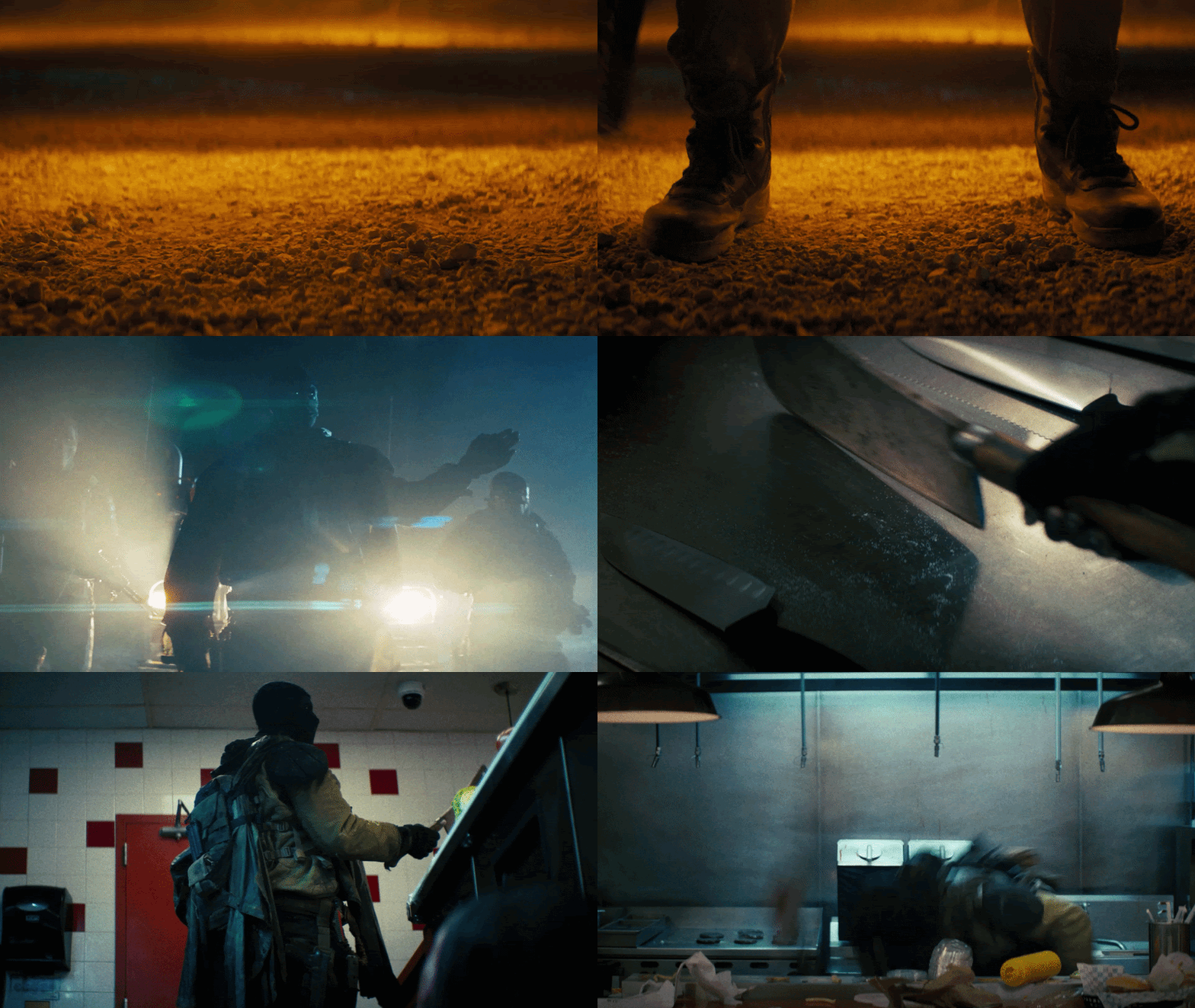
There is a particular brand of genre filmmaking that Adam Wingard and Simon Barrett have continued to return to throughout their careers. No matter how much larger the scale becomes, there remains an affection for the kind of violent, slightly ridiculous B-movie that feels like something discovered on television far later at night than you were supposed to be awake.
Onslaught feels like Wingard and Barrett coming home.
Backed by A24, the film reunites the collaborators behind You’re Next and The Guest for another action-horror hybrid that feels loosely connected to the world established by those earlier films. Whether this ultimately becomes an actual trilogy or the beginning of something larger remains to be seen, but Onslaught certainly gives viewers enough connective tissue to start looking backward.
Adria Arjona stars as Celeste, a former military sniper whose weekend takes an unexpected turn when she has to watch her daughter, Daisy, played by Blake Kennedy. Any hope for a normal weekend disappears when Celeste finds herself facing three former high-ranking military soldiers who have essentially been transformed into nearly indestructible killing machines.
Their objective isn’t complicated. They are built for destruction, and Celeste and her daughter are standing in their path.
From there, Onslaught settles comfortably into the kind of one-woman-army action movie its premise promises. Celeste is a kick-ass mother with the training necessary to fight back, giving Wingard plenty of opportunities to unleash gunfire, brutal confrontations and elaborate action choreography.
Arjona carries that material well. Celeste isn’t presented as an immaculately polished action hero, either. There is a rawness to the character that works tremendously in some moments, even if that lack of refinement can occasionally throw the film’s rhythm off.
Rebecca Hall, Dan Stevens and Michael Biehn are among the familiar genre faces surrounding her. Stevens, playing scientist Hans Kamler, is particularly at home within the strange universe Wingard and Barrett are constructing. The performances understand the assignment. This is heightened material, and nobody appears interested in pretending otherwise.
That becomes important because Onslaught requires viewers to put their believability meter on the shelf.
There are moments when the behavior of these supposedly relentless super soldiers doesn’t make much practical sense. If these killers exist solely to deliver devastation, their occasional tendency to grandstand rather than simply accomplish their objective raises obvious questions. Start pulling too aggressively at those threads and the entire thing becomes harder to accept.
But that’s also where understanding what Wingard and Barrett are making matters.
Onslaught isn’t striving for grounded military realism. This is drive-in action filmmaking. It is loud, violent, gnarly and intentionally indebted to the B-side genre movies that once filled late-night television schedules. The laboratories, government conspiracies, enhanced killers, shootouts and larger mythology are all pieces of that same playground.
And that mythology is where things become particularly interesting.
The potential connections between Onslaught, The Guest and You’re Next are difficult to ignore. The military backgrounds of the killers in You’re Next create intriguing possibilities, although any direct connection remains speculative within the film. The Guest, meanwhile, feels considerably closer to what Onslaught is doing through its government conspiracies, extraordinary human abilities and military experimentation.
There is enough here to make watching all three films together tempting, not necessarily because Onslaught provides definitive answers, but because it encourages the audience to start searching for them.
Wingard and Barrett also seem comfortable leaving some of those answers beyond immediate reach. Their films frequently operate with the sense that something larger exists outside the frame. Sometimes attempting to logically assemble every piece while the movie is still unfolding works against the experience. You have to invest in the story being told and allow the larger intent to reveal itself when, or if, the filmmakers decide it should.
For viewers already tuned into their wavelength, that shouldn’t be a difficult proposition.
There is something deeply nostalgic about Onslaught, but not in the increasingly common sense of simply recreating recognizable imagery from decades past. Its nostalgia comes from how genre movies were consumed. This feels designed for people who grew up watching USA Up All Night, late-night Cinemax and whatever action movie, monster movie, slasher or supernatural oddity happened to appear on television after everyone else had gone to bed.
Those movies embedded themselves differently in everyone who watched them. Some filmmakers emerged from that experience obsessed with melancholy, memory or the unsettling sensation of television itself. Wingard and Barrett seem to have retained something louder: the guns, monsters, conspiracies, unstoppable killers and unapologetic entertainment of it all.
That affection runs through Onslaught.
It isn’t always clean. Its internal logic occasionally bends under the weight of its own excess, and Celeste’s intentionally rough edges don’t work equally well throughout. But polishing away those imperfections might also remove some of what makes the film enjoyable.
Wingard may have graduated to enormous studio productions, but Onslaught suggests there will always be room in his filmmaking for something meaner, stranger and better suited for midnight.
It’s good to have Wingard and Barrett operating in this world again. More importantly, Onslaught leaves the door open just wide enough to make you wonder where they’re going next and whether we should have been connecting these dots all along.
3.5 out of 5


Wi-Fi systems are easier to manage when users understand their access and configuration options. The information about piso wifi provides a useful starting point for learning about connectivity, network access, and basic management features while keeping the explanation straightforward for readers.