


Posthumous Interview: Josh Tanner | Fantastic Fest 2026

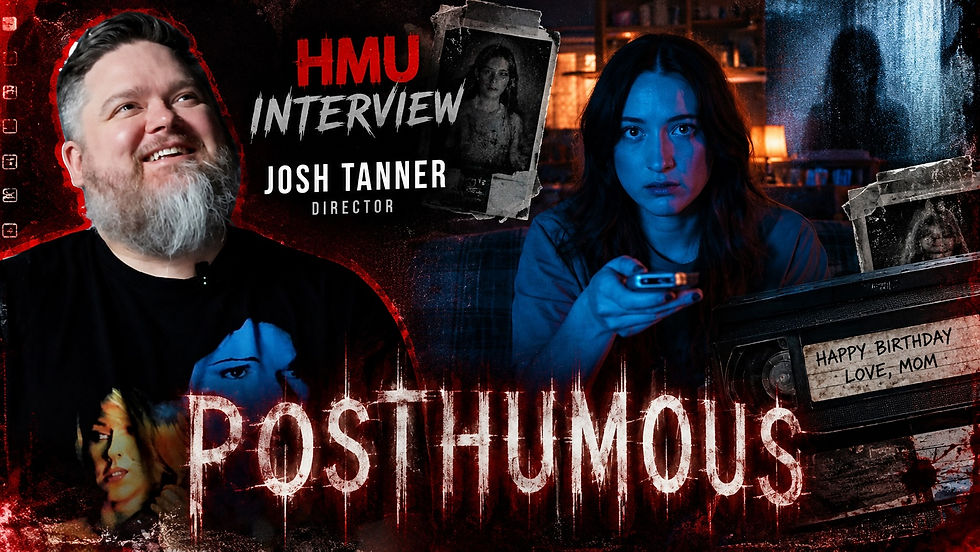
Fantastic Fest 2026: ‘Posthumous’ Director Josh Tanner on Grief, VHS and the Horror Hidden in Family Memory
Photo Caption: Posthumous director Josh Tanner speaks with Horror Movies Uncut and The Final Cut at Fantastic Fest 2026 about grief, analog media and Sophie Lowe’s performance.
Family history can become its own kind of mythology. For Posthumous director Josh Tanner, that idea becomes the foundation for a supernatural story in which old photographs, VHS tapes and messages from the dead force a daughter to reconsider how well she ever understood her own family.
Speaking with Horror Movies Uncut and The Final Cut during Fantastic Fest 2026, Tanner explained that the film’s earliest idea wasn’t a ghost or supernatural threat. It was something considerably more emotional: a mother recording birthday messages for a child knowing she would not live long enough to see those birthdays herself.
“I just thought that was such a sad idea, to have a parent be recording messages for a child that they’ll never see,” Tanner told HMU.
That concept became the doorway into Posthumous, which follows Zoe as she attempts to understand a mother she largely knows through images and recordings. The mystery surrounding those materials gradually opens the film into more unsettling territory, but Tanner’s starting point remained the emotional implications of communicating with someone after death.
That makes the film’s use of physical media more than an aesthetic choice. Photographs and videotapes become evidence of a life Zoe never completely experienced herself, allowing her to reconstruct the past one image at a time.
Tanner described those objects as “the markers of how we relate to the past,” particularly for a character whose understanding of her mother is so closely connected to recorded images.
The filmmaker also believes aging technology develops an inherent uneasiness as the audience’s relationship with it changes. VHS wasn’t frightening when it was simply the dominant way to watch movies at home. Decades later, the imperfections and physicality of the format carry something else with them: nostalgia, memory and the uncomfortable recognition of time passing.
“As technology gets older, it just sort of brings on this inherent creepiness,” Tanner said.
It’s an observation particularly suited to contemporary horror. VHS tapes, camcorders and analog recordings have become recurring genre devices, but Tanner’s interest isn’t limited to the distorted images they can produce. The physical object itself matters.
That tangibility also came up when the conversation turned to younger audiences rediscovering physical media. While streaming has made enormous libraries immediately accessible, a VHS tape, photograph, record or disc still represents something that can be held, stored and passed between people.
“There’s a tactileness and tangibility to having and owning,” Tanner said, arguing that something can feel more authentic when it exists outside a purely digital space.
Those analog influences extend into the film’s horror language. Tanner cited The Blair Witch Project and The Ring among the films that informed him, specifically pointing to Gore Verbinski’s American adaptation of The Ring as a movie that had a major effect on him.
That influence makes sense within Posthumous. The supernatural doesn’t always announce itself immediately. Much of the tension comes from observing images, waiting for something to reveal itself and questioning whether the significance of what Zoe is seeing has been understood correctly.
At the center of that experience is Sophie Lowe.
Tanner said the film was written with Lowe in mind after previously working with her, citing both her range and the particular qualities she could bring to Zoe. The character has to move through curiosity, grief, responsibility and increasingly uncomfortable discoveries while remaining emotionally grounded.
“One of the things that I knew that Zoe had to be was a bit of a mess,” Tanner said.
That becomes particularly important as Zoe is forced into an almost parental position before seeing her own emotional stability begin to fracture. Tanner also saw a childlike quality in Lowe that fit a woman who, emotionally, remains connected to the videotapes of a mother she never had the conventional opportunity to know.
That relationship gives Posthumous a different form of grief. Zoe isn’t simply mourning someone she once knew intimately. She’s trying to understand someone whose identity has largely been constructed for her through fragments.
For Tanner, however, putting a character through that darkness didn’t mean leaving the audience without emotional resolution.
“It’s so clearly a film about grief,” he said, adding that the filmmakers wanted to genuinely confront that grief while ultimately providing a sense of catharsis and the possibility that things could be okay.
Even the title emerged directly from that central idea.
Tanner said Posthumous was essentially there from the beginning. Although alternative titles were considered along the way — including after questions about the name from the distribution side — none captured the film in quite the same way.
“It’s a really enigmatic title,” Tanner said. “It makes you lean in.”
More importantly, its definition is embedded in the story itself: something occurring or experienced after death. The messages Zoe receives and the relationship she constructs through them make the title less a description of the supernatural than a description of the film’s emotional architecture.
When asked what he hoped audiences would carry with them after reaching the end of Zoe’s journey, Tanner returned to the range of experiences the film attempts to contain.
He wants viewers to feel as though they’ve gone through a complete journey — one capable of offering more heart than audiences might initially expect from its horror framework, without sacrificing the dread that brought them there.
For Posthumous, those two impulses aren’t opposites.
The old videotapes can be comforting because they preserve someone who’s gone.
They can also be frightening for exactly the same reason.
And somewhere between those two feelings is Zoe, trying to determine whether the images her family left behind are memories, evidence or warnings.

Looking for your next horror watch? Explore Bloodstream, an HMU streaming partner, for independent horror, cult discoveries, and more.
Affiliate disclosure: Horror Movies Uncut may earn a commission when you subscribe through this link, at no additional cost to you.


Comments