


‘V/H/S Mixtape’ Review: A Killer Playlist Gets Lost in a Sloppy Mix


With names like Ernest Dickerson, Flying Lotus, RZA, GWAR and Ghost frontman Tobias Forge involved, V/H/S Mixtape arrives sounding less like another anthology installment and more like an opportunity for the franchise to completely cut loose.
Throw Barbara Crampton and Mike Ferguson into that collection of genre personalities and expectations become even harder to temper. The V/H/S franchise has spent years handing filmmakers a camera, a concept and seemingly just enough freedom to create their own compact glimpse of carnage. Bringing musicians into that formula — particularly artists already associated with distinctive, sometimes transgressive visual identities — feels like a natural extension.
That makes V/H/S Mixtape one of the more interesting experiments in the series.
Unfortunately, it may also be one of its sloppiest.
That disappointment is amplified by how consistently the franchise has reinvented itself in recent years. The themed approach of the newer installments has helped answer one of the inevitable questions surrounding any anthology series approaching double-digit entries: How long can this thing keep going before somebody runs out of ideas?
So far, V/H/S has been remarkably resilient.
There is something appropriate about that longevity, particularly at a moment when physical media has once again become an important part of genre culture. The format itself is now part nostalgia, part aesthetic and part storytelling device, allowing filmmakers to continually reinterpret what a “VHS movie” can actually be.
Mixtape should have been another strong argument for that flexibility.
Instead, it often feels like an album containing several good tracks without enough thought given to how they should fit together.
The individual segments aren’t really the fundamental problem. Some are stronger than others, naturally, but there is enough creativity throughout the anthology to understand why these filmmakers and musicians were invited into the V/H/S sandbox in the first place. Even the shorts that don’t completely land contain ideas or imagery suggesting what they might have become with a little more room.
Flying Lotus’ animated contribution is one example. The animation works, and the segment has personality, but it feels as though there is considerably more territory available than the film ultimately explores. Rather than overstaying its welcome, it leaves the opposite impression: there was another gear available that never quite gets engaged.
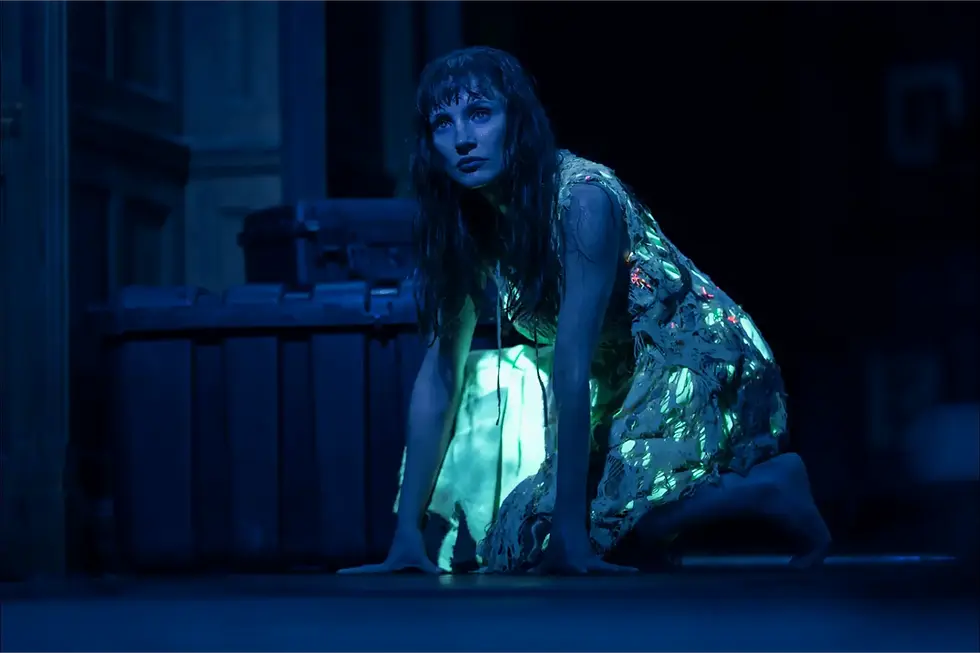
Ernest Dickerson delivers one of the anthology’s strongest contributions with the story involving the mysterious violinist upstairs. It feels particularly compatible with the DNA of V/H/S: a relatively simple premise, an unsettling discovery and the sensation of watching something that perhaps should never have been recorded in the first place.
It also feels unmistakably suited to Dickerson’s sensibilities. There is a purity to the segment that recalls what has always made the franchise work at its best. The concept doesn’t need an enormous mythology surrounding it because the presentation itself creates curiosity, dread and escalation.
The ASMR segment is another standout and arguably the anthology’s smartest conceptual swing.
ASMR is already an oddly intimate corner of internet culture, built around repetition, sound, physical sensation and the strangely hypnotic relationship between performer and viewer. Turning that fascination toward increasingly excruciating horror is exactly the kind of contemporary mutation V/H/S should be attempting. It recognizes something millions of people already consume online and asks what happens when the comforting sensory experience becomes unbearable.
Those moments make Mixtape frustrating because they demonstrate how strong the central idea could have been.
The larger problem is the material connecting everything together.
GWAR handling the wraparound sounds fantastic on paper. Their theatricality, grotesque imagery, music and decades of gleefully excessive performance art should make them almost perfectly engineered for V/H/S. The issue isn’t the decision to use GWAR. It’s that the wraparound never becomes engaging enough to create anticipation for what is coming next.
That connective tissue matters more than it may initially seem.
The strongest V/H/S entries don’t simply present a collection of unrelated shorts. Their framing devices help create the sensation that the viewer has stumbled onto something forbidden, contaminated or dangerous. Even when the mythology is deliberately loose, there is momentum between the tapes.
Here, that momentum repeatedly dissipates.
The result is an anthology whose individual filmmakers frequently seem more energized than the movie containing their work.
There are other areas where familiarity begins creeping in. Horror’s continuing fascination with children’s television, puppets and corrupted kids’ programming is reaching the point where simply introducing cheerful characters with something sinister underneath is no longer enough. The involvement of Jim Henson’s Creature Shop gives the material an obvious level of craftsmanship, and seeing that kind of creature work operating directly inside the horror space is undeniably fun.
But craftsmanship doesn’t automatically make the concept fresh.
The genre has spent years exploring sinister children’s programming, puppets and nostalgia warped into nightmare fuel. At this stage, another trip into that territory needs a particularly strong angle to separate itself from an increasingly crowded field.
That ultimately describes much of V/H/S Mixtape: good ingredients searching for a stronger arrangement.
The anthology is entertaining. The segments aren’t failures. Several are genuinely good, and almost every filmmaker involved provides at least a glimpse of what made their inclusion exciting in the first place.
But an anthology is more than the mathematical average of its individual shorts.
It needs rhythm.
That becomes especially important for something calling itself Mixtape. A great mixtape isn’t simply a stack of good songs. The sequencing matters. The transitions matter. The personality of the person assembling it matters. One track should make the next one feel inevitable.
V/H/S Mixtape never completely finds that flow.
There is still something admirable about seeing the franchise continue experimenting this far into its run. Bringing musicians and filmmakers from different creative backgrounds together gives this installment a personality distinct from the other themed entries, and there will almost certainly be a community of horror fans who are equally devoted to underground music, metal and experimental art who connect much more strongly with what the film is attempting.
That distinct identity may also help Mixtape develop a cult following within the larger V/H/S audience.
And like most entries in this franchise, individual segments will likely become easier to appreciate on repeat viewings, removed from the expectations surrounding the complete anthology. V/H/S has always encouraged that kind of revisiting. Everyone eventually develops their own playlist of favorite tapes.
There are absolutely a few from Mixtape worth adding to that collection.
It’s the mixtape itself that needed a better mix.
HMU Rating: 3 out of 5 stars


Comments